
Concerns over policing and freedom of assembly during Europe’s protest wave

In October 2026, largely peaceful demonstrations took place against rising living costs, poor education, public services, and other social issues across several countries. Protests, largely driven by young people, have taken place across Albania, Austria, Belgium, France, Greece, Italy, Portugal, and Spain.
During these largely peaceful protests, there have also been reports of individuals participating in violence and vandalism against public and private property. In many countries, experts have accused police of responding with disproportionate, excessive, and sometimes unlawful use of force. Authorities have also issued bans on protests and engaged in political rhetoric portraying protesters as “security threats”, raising concerns about the protection of the right to peaceful assembly. In some countries, governments have increased security measures, including the deployment of armed forces on onto the streets — a response which has led to questions about escalation and the suitability of military personnel for crowd control.
The UN special rapporteur on freedoms of association and peaceful assembly, Gina Romero, urged states to address the concerns of the youth, and to ensure their response is “focused on dialogue and not on unnecessary use of force.” She added that “even when a protest turns violent, the right to live and the absolute prohibition of torture and ill treatment need to be ensured, as well and guarantees of due process for detainees. The presence of violence and the dispersal of protests is no justification for silencing journalists, legal observers, or street medics.”
In a statement on 20 October, UN High Commissioner for Human Rights Volker Türk raised serious concerns about the state responses to protests across Europe and the unnecessary and excessive use of force against protesters, including children. He also stressed that those who “commit acts of violence and vandalism against public and private property […] should be held individually accountable.” Additionally, he reiterated that states also have a duty to ensure that allegations of unlawful use of force are “investigated promptly, effectively and independently, with accountability and effective remedies for victims.”
According to international human rights standards, even when violence occurs during protests, states have an obligation to facilitate the right to peaceful protest, rather than seeking unnecessary and disproportionate limitations on it. Law enforcement officials should seek to de-escalate situations that might result in violence. The conduct of some participants does not automatically deprive an entire assembly of protection. Authorities should distinguish between individuals engaging in violence and those participating peacefully. They must exhaust non-violent means and to give prior warning if it becomes absolutely necessary to use force, unless doing either would be manifestly ineffective. Any use of force must comply with the fundamental principles of legality, necessity, proportionality, precaution, and non-discrimination, and those using force must be accountable for each use of force.
In Belgium, an estimated 50,000 people gathered in Brussels as part of a national strike against the government’s austerity measures. During the largely peaceful mobilisation, police reportedly used kettling, tear gas, and water cannon, and arrested 100 people, including minors. According to and civil society reports, teenagers were physically assaulted and verbally and racially attacked by police. International human rights standards point out that tear gas and water cannon tend to have indiscriminate effects and that such weapons should be used only as a measure of last resort, following a verbal warning, and with adequate opportunity given for assembly participants to disperse.
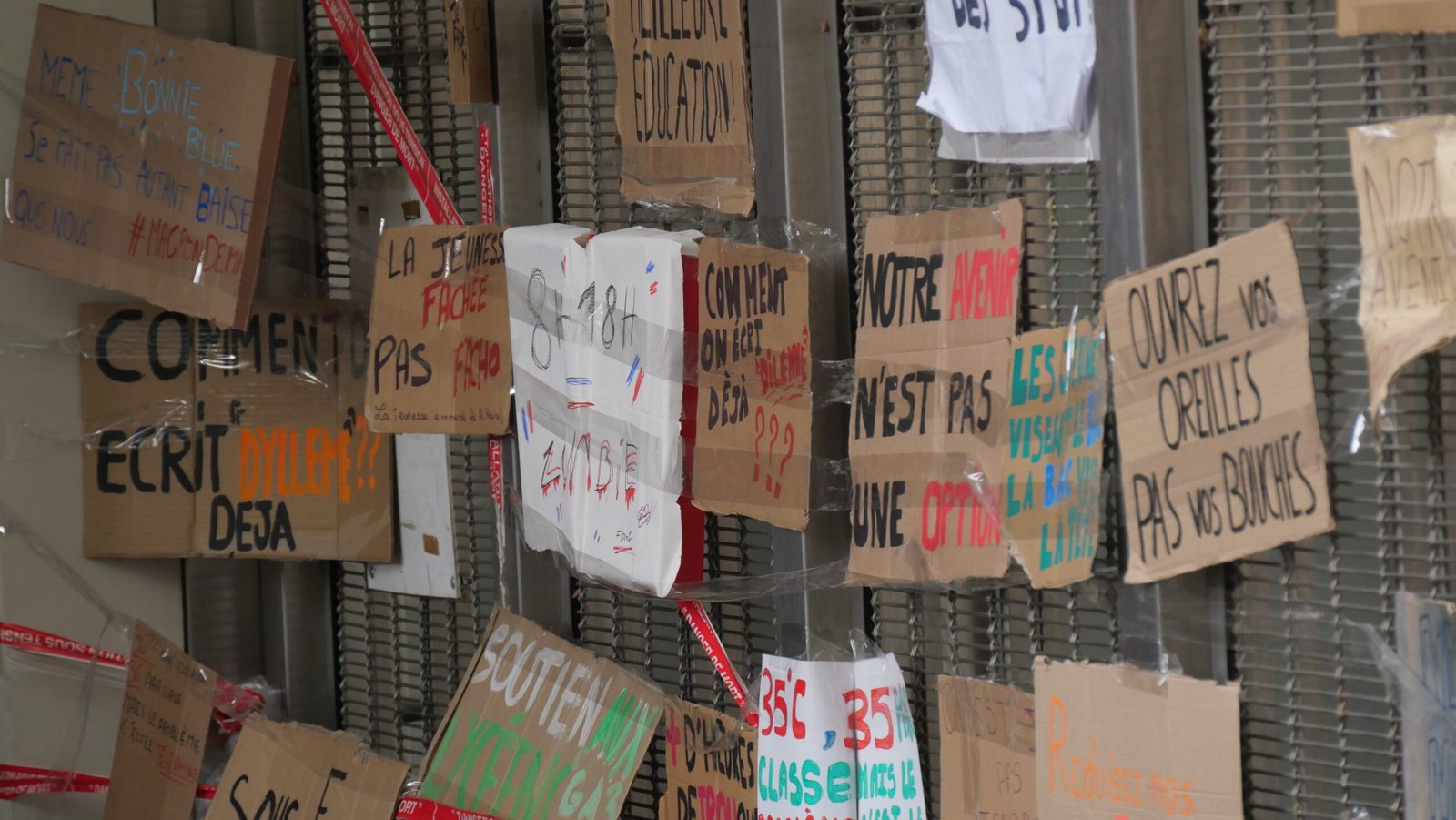
In France, during September and October thousands of young people have staged largely peaceful protests to demand equal access to good education, better conditions and facilities in schools, and an end to overcrowded classrooms and teacher shortages. Later the movement expanded to include broader calls against the cost-of-living crisis. The police response which has resulted in multiple injuries, has triggered national and international concern. French authorities have also implemented emergency restrictions, including curfews across multiple cities. According to a guide on the right to protest by Article 19, “states should not resort to declaring a state of emergency in order to limit protests, being cognisant that protests extremely rarely give rise to circumstances that meet the threshold for legitimate derogation”. On 22 October, President Emmanuel Macron stated that demonstrations organised by groups “without legitimacy” would be banned in the coming days, with only those led by recognised groups like trade unions allowed to go ahead. Banning or prohibiting an assembly should always be a measure of last resort, as per international human rights standards. Human rights groups have taken action and are challenging several of the banning orders and courts rejected the bans in some cities.
On 21 October, more than 20,000 students, school pupils, teachers, and public sector workers protested in Athens and other cities in Greece. The protesters demanded increased public funding for education, safer school buildings, additional teaching staff, higher wages, and greater support for students facing rising rents. The protest was a follow-up to a teachers’ strike earlier in the month. The protest in Athens took place under heavy security, with approximately 3,000 police officers deployed. Reports indicate that over 20 people were taken in for questioning.
In Italy, in response to violent incidents during protests in Milan, the government approved a new security decree and deployed 500 soldiers on the streets of Milan. This is the eighth security measure passed during the current government’s mandate. The new decree introduces tougher policing measures, particularly on minors, and has prompted concerns that it could impose additional criminal penalties or restrictions on protest-related activities. Meanwhile, since mid-October peaceful protests have been staged by truck drivers and farmers in the south of Italy through roadblocks, protests at toll booths, distribution slowdowns, while during the weekend of 24-25 October, peaceful student protests took place across the country. In Bologna, Turin, and Florence, media accounts described police charged the crowds and used batons, while in Milan and Rome, the demonstrations took place under heavy security. In Bologna, water cannon was used while paramedics were tending to an injured protester.
In Portugal, on 25 October, largely peaceful housing-rights protests and encampments in Lisbon and Porto were reportedly dispersed by the special police unit, who used batons and deployed police dogs, riot equipment and less-lethal projectile launchers. Protest organisers report that rubber bullets were fired resulting in dozens of injuries, while the authorities reported 11 injuries and 31 arrests for “disobedience”. Senior national and municipal officials have repeatedly framed the encampments as unlawful occupations, deliberate provocations, or potential sources of disorder.
Spain has also witnessed mass protests for housing rights in recent weeks, marking the country’s most significant housing mobilisation in years. On 23 September, hundreds of activists were removed by the police during the eviction of Maricarmen Abascal, an 87-year-old tenant with disabilities, who had lived in her flat in Madrid’s Retiro district for over seventy years. Observers reported police violence, beatings with batons, and the use of pepper spray to remove journalists from the area. On 3 October in València, the National Police arrested five people and used batons, rubber bullets, and tear gas against the protesters, including children and elderly people, gathered outside the Palau de les Arts, where the Real Estate Summit 2026 was being held.
Meanwhile, in Germany, nationwide youth protests are planned for 31 October. Conservative politicians have already issued warnings and accused “far-left extremists” and the ‘migrant community’ of infiltration and voiced general suspicion on the protests.