

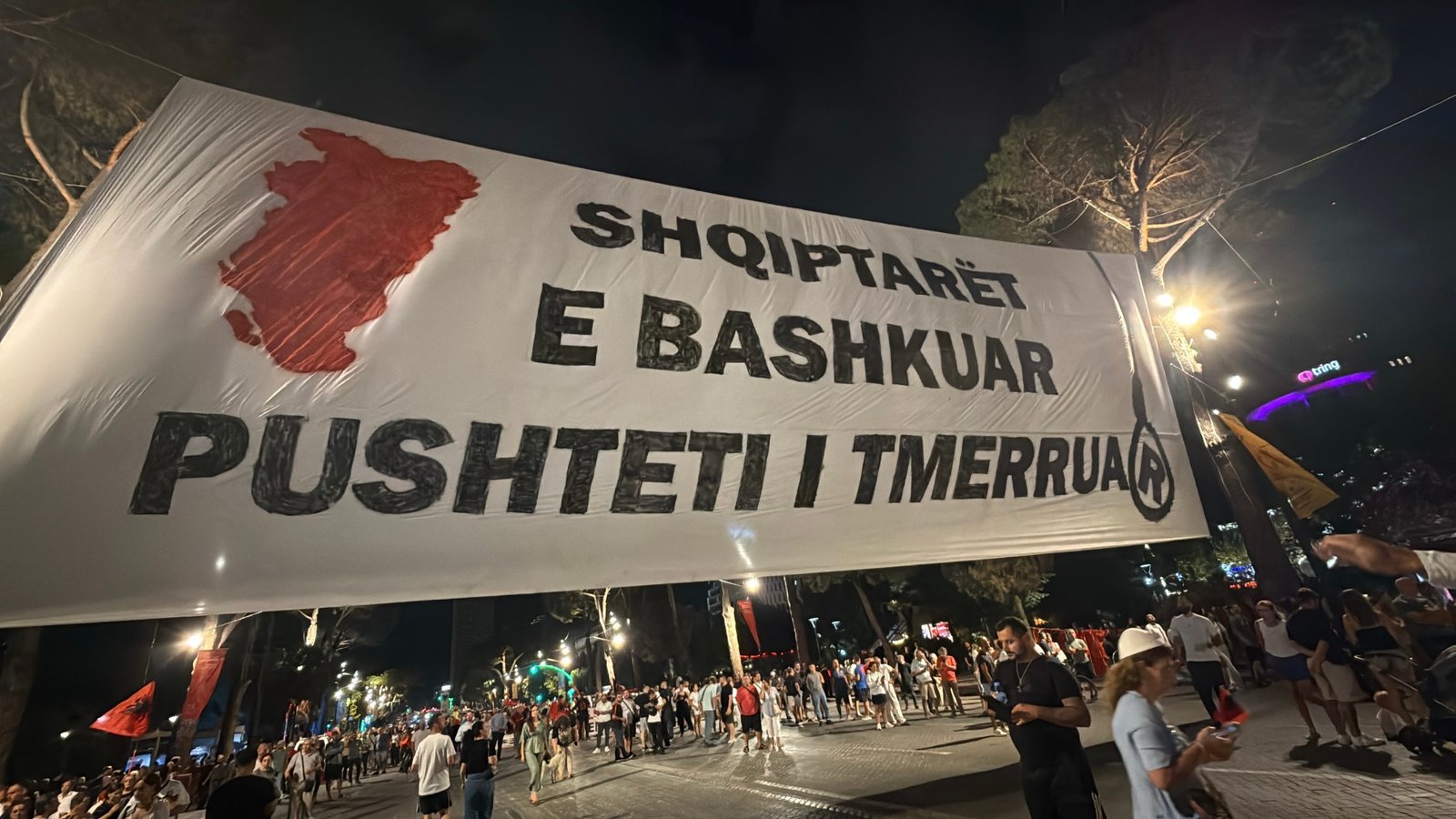
ALBANIA: 100 days of anti-government Flamingo revolution protests


For over 100 days, thousands of Albanians, many of them young people and students, have gathered in daily protests in Tirana and across the country, making it the biggest anti-government protest movement against Prime Minister Edi Rama’s government. Albania’s “Flamingo Revolution” began in May 2026 as opposition to luxury tourism development projects on the protected Vjosa-Narta wetlands near Sazan Island. The projects are linked to Donald Trump’s son-in-law, Jared Kushner, and his investment firm, Affinity Partners. What began as protests against environmental damage and plans to limit public access to the coast quickly evolved into the country’s largest sustained mobilisation since communism fell, expanding into broader demands for transparency in construction projects and deals, opposing corruption, and the government’s economic, social, and environmental policies.
Recent investigative reporting from Balkan Insight reveals that authorities have approved additional development permits for hotels and tourist resorts in protected areas. These permits, granted in May and June 2025 while protests were ongoing, validate the Flamingo revolution movement’s fears that the Kushner project was not an isolated case but part of a broader pattern of opaque foreign investment threatening the protected areas and locals. Civil society organisations are also calling for the repeal of the 2024 amendments to the Law on Protected Areas and to restore the legal framework established in 2017 that strengthened nature protection standards in Albania. According to the organisations, the 2024 amendments paved the way for the construction boom in ecologically sensitive areas.
The government has responded with delegitimisation, stigmatisation, and repression. Prime Minister Rama has personally accused protesters of foreign interference and serving foreign interests and described the movement as a “hybrid war”, while minimising the numbers of protesters and their demands and significance. Authorities have targeted journalists and activists associated with the movement, and protesters have been met with disproportionate police force, such as tear gas, pepper spray, and water cannons, mass detentions and also violence from private security guards at the protests in protected areas. Human rights observers have raised serious concerns about the implications for civic freedoms of the government’s approach to the protests and the wider democratic backsliding by Rama’s government in recent years in Albania.