
FRANCE: Severe crackdown on the right to protest


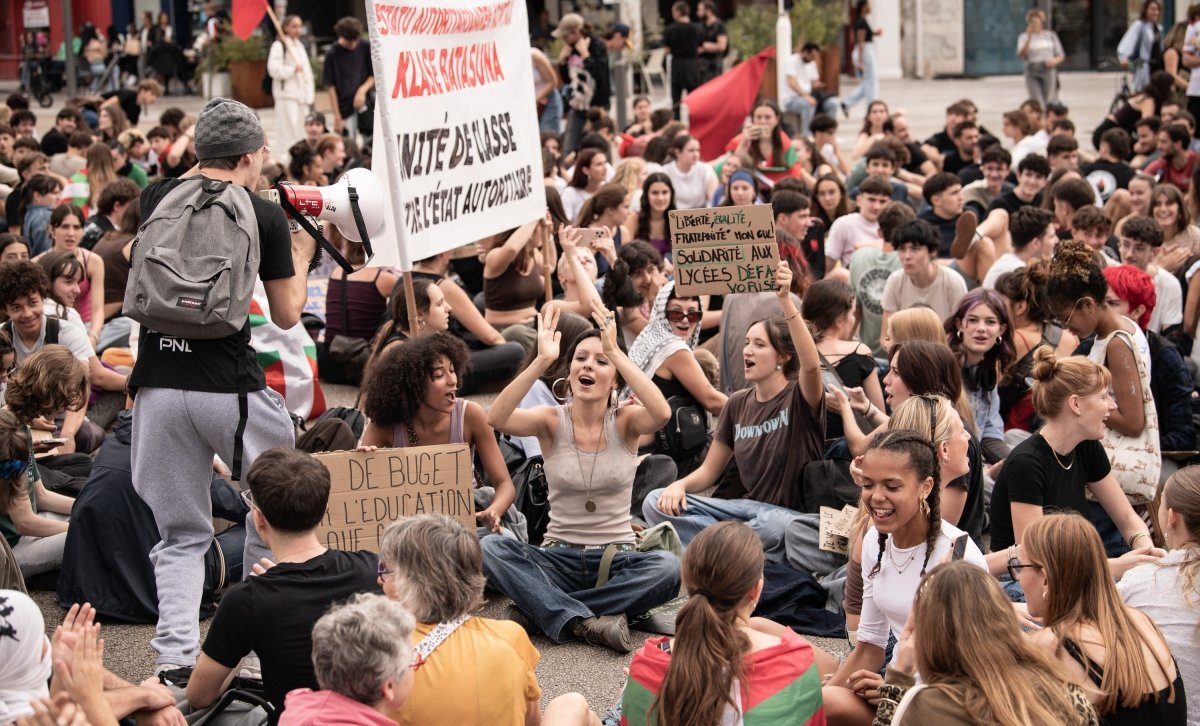
France is facing a severe crackdown on protest rights and civic freedoms, following the student protests that started in September and expanded throughout October. Mass demonstrations on 17 October saw high participation across France. According to trade unions and civil society, 800,000 people took part in cities across the country. Similar numbers came out onto the streets again one week later. Alongside the largely peaceful demonstrations, there were reports of violence, damage to public property, and looting by some individuals
The movement, which began with demands for equal access to good education, better conditions and facilities in schools, and an end to overcrowded classrooms and teacher shortages, expanded to include broader calls against the cost-of-living crisis. Other movements, such as the Yellow Vest movement and various trade unions, have also joined the protests.
The demonstrations have faced severe repression and injuries that have triggered national and international concern over France’s policing of protests. On 17 October alone, there were over 2,000 arrests nationwide. In Saint-Étienne, a 17-year-old boy lost his hand after being struck by a police grenade. In Mulhouse, a 17-year-old girl lost an eye from similar weapons, adding to the several previously reported cases of severe injuries caused by police violence. On 24 October, police again reportedly used excessive force and tear gas against demonstrators, and an investigation was opened after another member of the public faced serious injuries caused by a police grenade.
Civil society groups have raised concerns about the violence from law enforcement, the unprecedented numbers of minors in police custody, and alleged racial discrimination during detention. The French Human Rights League (LDH) emphasised in a press release on 19 October that “the compass of the public authorities must be the rule of law, respect for rights and freedoms, and social justice”. The expedited prosecution ordered by the justice ministry (a procedure called comparution immédiate) raised serious rule of law concerns among lawyers and rights groups. The justice minister called for the justice system to be “extremely firm” and “ruthless” against people involved in vandalism and theft during the protests and even called for the removal of their voting rights.
Authorities have also implemented emergency restrictions. Curfews were imposed across multiple cities, and the route for the demonstration in Paris on 24 October was changed at the last minute by authorities. President Emmanuel Macron stated on Thursday 22 October that demonstrations organised by groups “without legitimacy” would be banned in the coming days, with only those organised by recognised groups like trade unions allowed to go ahead. Human rights groups have taken action and are challenging several of the banning orders and courts rejected the bans in some cities.
The interior minister announced on 20 October that special heavy police forces will be deployed in future mass protests, including the Investigation and Intervention Brigade (BRI), specialised in serious crime and the counterterrorism units RAID (Recherche, Assistance, Intervention, Dissuasion) and the National Gendarmerie Intervention Group (GIGN). The French Human Rights League (LDH) has requested the High Commissioner for Human Rights to carry out a mission to monitor upcoming protests, pointing out that these forces are not trained to handle protests, and are subject to less oversight.
According to international human rights standards, even when violence occurs during protests, states have an obligation to facilitate the right to peaceful protest, rather than seeking unnecessary and disproportionate limitations on it. Law enforcement officials should seek to de-escalate situations that might result in violence. They are obliged to exhaust non-violent means and to give prior warning if it becomes absolutely necessary to use force, unless doing either would be manifestly ineffective. Any use of force must comply with the fundamental principles of legality, necessity, proportionality, precaution, and non-discrimination, and those using force must be accountable for each use of force.
The protests may be further fuelled by a shooting near Paris on 23 October, described by Macron as a “racist terrorist attack”, that killed a young Black man and injured five others. Although there is no direct link between the murder and the protests, the incident highlights broader issues of racism and inequality, against which demands for social justice are being raised.